An initiative by Imdad e Hasan Charitable Foundation (IHCF)


“Free” Islamic Studies at Jamia Hamdard with Full Fee Assistance from IHCF for Underprivileged and Aid Mustahiq Students (Share with who Need this)
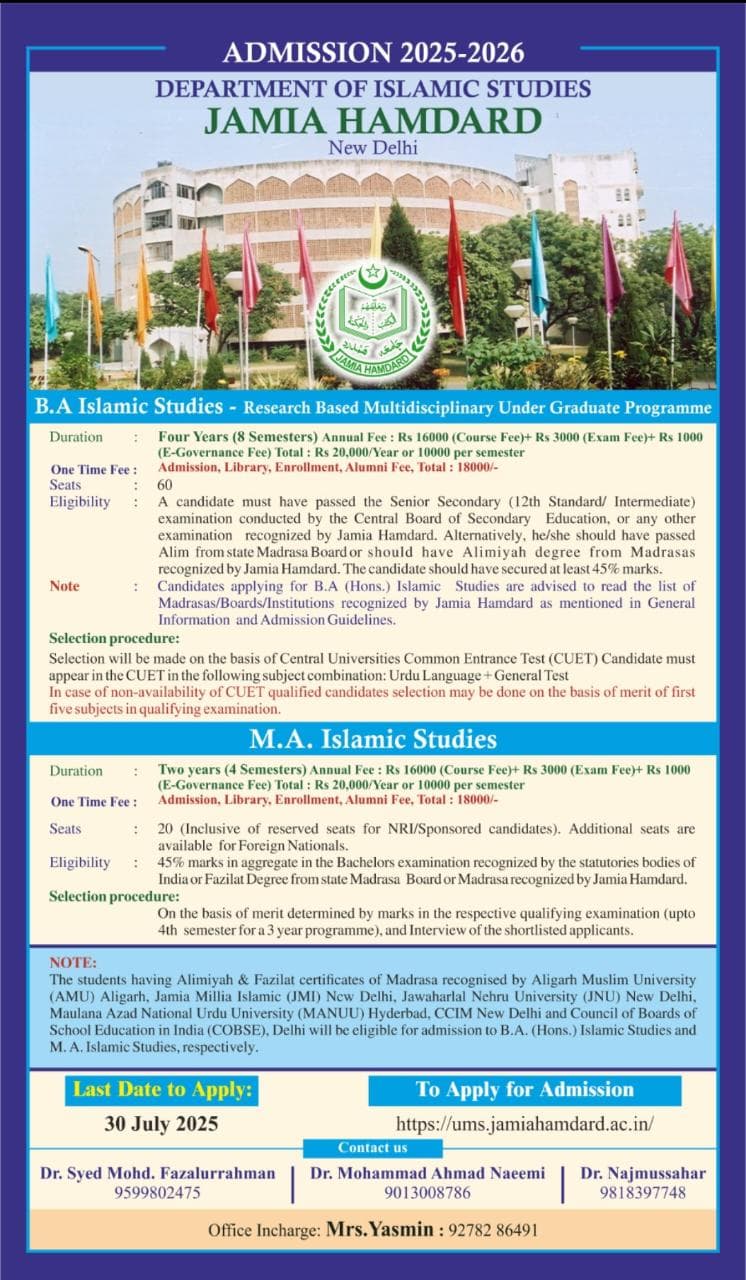
For students passionate about exploring the rich intellectual legacy of Islamic thought and culture, Jamia Hamdard in New Delhi offers an extraordinary opportunity—and now, financial constraints need no longer be a barrier. Thanks to LocalZakat.com, an initiative of the Imdad e Hasan Charitable Foundation (IHCF), eligible Muslim students can receive full fee assistance for both undergraduate and postgraduate programs in Islamic Studies.
Let’s take a detailed look at these transformative programs and how you can apply.
🎓 B.A. (Hons.) Islamic Studies: Build Your Foundation
Jamia Hamdard’s Bachelor of Arts in Islamic Studies is a research-based, multidisciplinary program designed to give students a deep understanding of Islamic theology, philosophy, history, jurisprudence, and literature.
📅 Duration
Four years (8 semesters)
💰 Fee Structure
Category Amount
Course Fee ₹16,000/year
Exam Fee ₹1,000/year
Other Fees ₹3,000/year
Total Annual Fee ₹20,000/year
One-Time Fee ₹18,000 (includes Admission, Library, Enrollment, Alumni Fee)
🧠 Eligibility
Must have passed 12th grade (Senior Secondary/Intermediate) from a recognized board.
Alternatively, candidates with an Alimiah degree from a madrasa recognized by Jamia Hamdard are eligible.
Minimum marks required: 45% in the qualifying exam.
📝 Selection Process
Preferred: Score in the Central Universities Common Entrance Test (CUET) using Urdu Language + General Test.
If CUET-qualified candidates are unavailable, selection will be based on merit (top five subjects in the qualifying exam).
📦 Seats Available
Total: 60
📚 M.A. Islamic Studies: Advance Your Expertise
Take your knowledge to the next level with a Master of Arts in Islamic Studies, a program focused on advanced topics in Islamic thought and scholarship.
📅 Duration
Two years (4 semesters)
💰 Fee Structure
Same as B.A. program:
Category Amount
Course Fee ₹16,000/year
Exam Fee ₹1,000/year
Other Fees ₹3,000/year
Total Annual Fee ₹20,000/year
One-Time Fee ₹18,000 (includes Admission, Library, Enrollment, Alumni Fee)
🧠 Eligibility
A bachelor’s degree with minimum 45% marks from a recognized institution
Or Fazilat degree from a recognized state Madrasa Board
📝 Selection Process
Based on academic merit (up to 4th semester for 2-year Bachelor’s programs)
Interview of shortlisted candidates
📦 Seats Available
Total: 20
Includes reserved seats for NRI/Sponsored candidates
Additional seats for Foreign Nationals
💡 Special Note for Madrasa Students
Students holding Alimiyah & Fazilat certificates from madrasas recognized by:
AMU (Aligarh Muslim University), JMI (Jamia Millia Islamia), JNU (Jawaharlal Nehru University), MANUU (Maulana Azad National Urdu University), CCIM, and COBSE are eligible for admission.
🕋 Fee Assistance for Underprivileged Muslim Students: Powered by LocalZakat.com (IHCF)
Thanks to the Imdad e Hasan Charitable Foundation (IHCF) and its platform LocalZakat.com, eligible Muslim students admitted to B.A. or M.A. Islamic Studies can receive complete course fee coverage.
🎉 That’s right—your tuition, exam fees, and other charges can be fully sponsored!
✨ What You Need to Do:
Ensure eligibility
Prepare for and take the entrance exam
Secure admission
Apply for fee assistance via LocalZakat.com (details usually shared upon admission)
📞Contact: Er. Iftikhar Hasan 9044511353 (After Admission Confirmation)
🗓️ Important Dates & How to Apply
Last Date to Apply: 30 July 2025
Application Portal: ums.jamiahamdard.ac.in
📞 Contact for Queries regarding the Course
Feel free to reach out to the following faculty members for help or clarification:
Name Contact Number
Dr. Syed Mohd. Fazalurrahman 9599802475
Dr. Mohammad Ahmad Naeemi 9013008786
Dr. Najmussahar 9818397748
Mrs. Yasmin (Office Incharge) 9278286491
🌟 What Can you do as an only Reader of this Blog:
If you or someone you know dreams of studying Islamic Studies and making a meaningful impact, this is the moment to take that first step.
So don’t wait—share this blog, help spread the word and empower the future of Islamic scholarship!